For Businesses
Operational Architecture & Executive Consulting for Behavioral Health Agencies
Balancing clinical integrity with financial survival shouldn't feel like an impossible compromise.

Executive Reality in Behavioral Health
Behavioral health work is about changing lives. But somehow, most of your week is spent putting out operational fires.
Most likely, you’re up against one (or both) of these common traps:
Productivity Friction: Your team is mission-driven, not billing-focused. They are working hard to make sure that the people you serve get what they need, but there is a gap between what needs to happen to keep the doors open and where the passion lives. You are left carrying the stress of keeping the lights on (and payroll flowing) while trying to get your team to buy into the importance of revenue-generation, even when profit isn’t the prize.
Contractual Optimism: Your funding sources barely (or don’t) cover basic operational costs. You want to pay competitive wages and fund the infrastructure that makes this work effective. But you don’t want to skip out on the community or lose important partnerships by over-leveraging your contracts.

The Dual-Lens Solution
As a Licensed Clinical Psychologist and former C-suite executive who supported agency growth from 25 to 250 employees and 2x revenue growth in under 2 years, I know how to bridge the gap between clinical ethics and operational excellence.
Our Transformation Approach
Productivity & Billing Workflows
Challenge
Staff view billing targets as antithetical to client care, causing missed revenue goals.
Our Solution
Reframe documentation and billing into human-centered workflows that clinicians understand and adopt without burnout. Create clear accountability and leadership buy-in.
Contract & Margin Optimization
Audit Compliance & Systems
Challenge
State and county audits create operational friction and team anxiety.
Our Solution
Build bulletproof Quality Assurance (QA) infrastructure that passes audits cleanly. Reduce internal friction through proactive and collaborative (not punitive) oversight.
Challenge
Contracts fail to fund true operational costs, infrastructure, or fair compensation.
Our Solution
Restructure program operations and resource allocation to stretch contract dollars and build sustainable overhead margins. Renegotiate unsustainable funding, identifying leverage points for funders.
We’re a Great Fit If:

Advocating for improved reproductive health and safety during a fundraising event for a local rape crisis center ca. 2011.
You run a California non-profit, group practice, or behavioral health agency facing contract squeezes or productivity gaps.
You refuse to solve financial deficits by exploiting or burning out your clinical team.
You want battle-tested operational frameworks from an executive who gets the heart behind your work - and the numbers on your spreadsheet.
You like clarity, direction, actionable input, and real outcomes.
You are ready to see the reality behind your organization’s current circumstances.
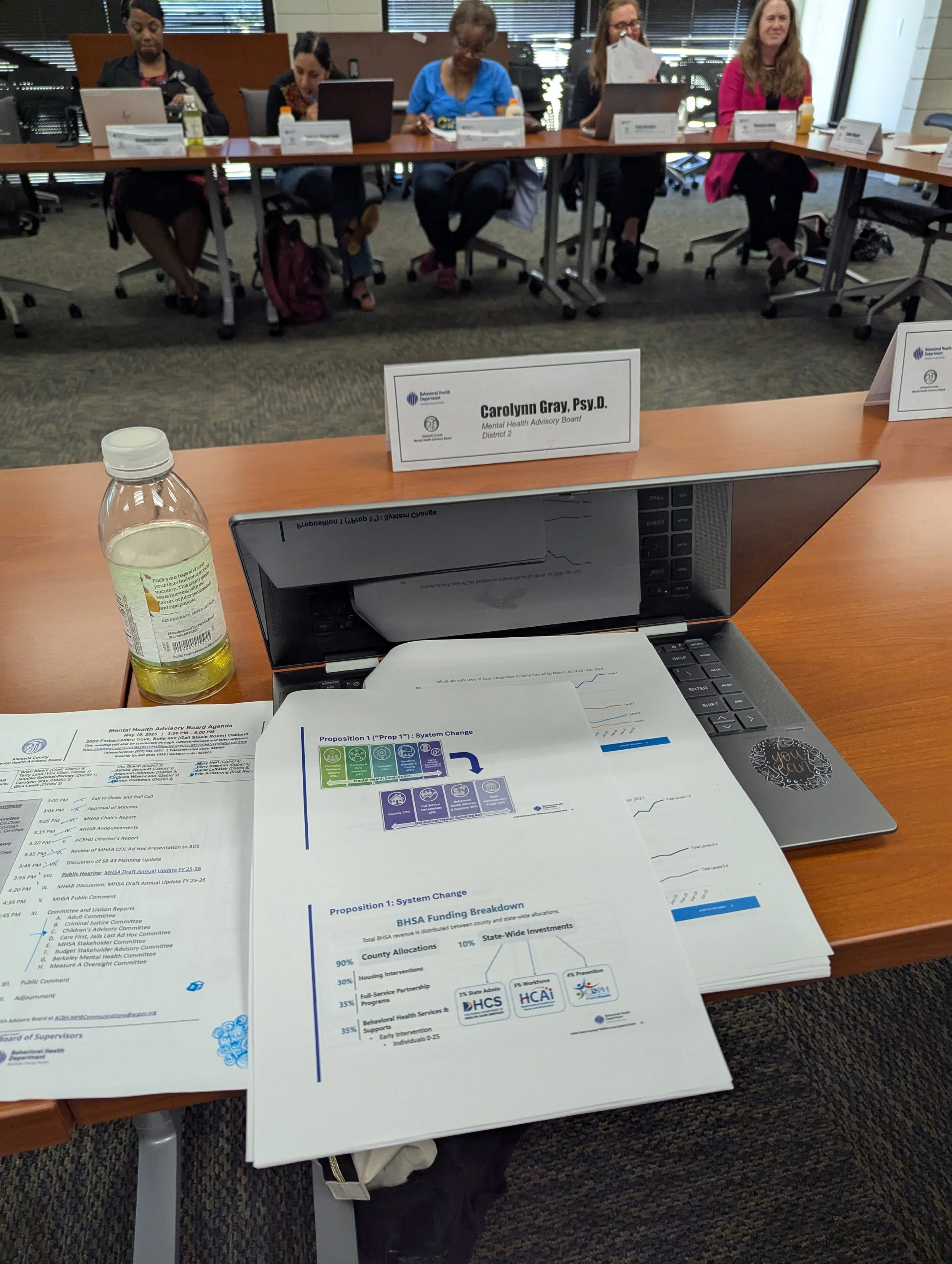

My seat on Alameda County’s Behavioral Health Advisory board for several years.
The Cost of Broken Systems

Data Integrity
As an early-career clinician, my first performance evaluation came as a shock almost two years into the job. One piece of feedback was not only frustrating to receive, it was not based in operational reality and did not support the conclusions he presented. Instead, it pointed to a lack of operational structure - both for timely and effective feedback processes and for data collection regarding client care.
My supervisor identified a single data point - the total number of client appointments marked as a “No Show” - and concluded that I must struggle in connecting with my clients.
What he missed was:
I met or exceeded my billing goals each month - something most of my colleagues were unable to achieve. This data point was not considered in my feedback.
My colleagues were simply skipping entering the “No Show” in our system. At the time, the organization had no meaningful quality review processes. After speaking to my peers, it turns out: I was the only one consistently and accurately marking “No Shows” per our contract requirements.
That is, it seemed my supervisor was operating with major blind spots, missing importance information due to a lack of clear processes or structure.
This same supervisor had also been telling me for nearly two years that I was doing a good job, and that I was on track for leadership.
This evaluation was so far off the mark, and so detached from daily feedback opportunities, I was on my way to finding another workplace. Not because I was not open to criticism, but because it was clear that I was not being accurately seen nor supported in building my skills. Thankfully, our CEO saw something different and I was able to take leaps into my future and take on leadership within a few months of this evaluation.
I would later learn that the original supervisor was attempting to block my promotion, suggesting that this performance evaluation was an attempt at reducing my chances of success. This is the kind of leadership behavior that tanks organizations, when allowed to run rampant.
As part of my leadership in that same organization, we established:
Clear and consistent quality review processes for clinical documentation;
Performance data tracking systems for individuals, programs, and agency-wide;
Regular, standardized, formal performance evaluations;
A “Radical Candor” feedback culture and growth mindset;
Training on performance and feedback for all new organizational leaders;
Standardized program manuals, which included Key Performance Indicators (KPIs) for all programs.

Onboarding Risk
Two conversations I had not that long ago, both nearly back to back:
With leadership: “You new supervisee, she just graduated, so she’s really green. She doesn’t have any experience with kids, so you may need to help her with that.”
With my new supervisee: “I’ve never worked with kids before, but they just assigned me a 7-year-old. So I’m hoping we have time to talk about that case today, because I’m not really sure what to do.”
This is a lawsuit waiting to happen - either from the clinician or a client.
This clinician - a newly graduated associate - is being asked to practice outside her scope. When put this way, it should be clear that that is an unethical expectation in the workplace.
In this example, the new employee had not received any formal training in modalities focused on children. No such training was offered by the employer.
If the clinician wanted to expand her skills, she could do so on her own time and dime or get what she could in supervision.
When new clinicians are asked to practice outside their scope by their leaders, they are prone to Moral Injury and Burnout.
Organizations can protect against these liabilities by:
Creating consistent onboarding training in select topics and modalities;
Determining a scope of practice match before extending a job offer;
Supporting formal external training for new hires who need to fill in scope of practice gaps;
Developing or updating in-house formal graduate training programs.
My favorite and most accessible option is a consistent onboarding training. This allows organizations to determine their view on how this work works best for their population(s), and choose what clinical training is most useful for those folks.
Choosing the lenses and the modalities both, and then providing a baseline training to all new hires is key to clinical consistency and a positive, supportive experience for clinicians.
Clinicians who feel supported are less likely to turnover (a major issue for most behavioral health leaders).
Gaps in staffing and potential lawsuits are both extremely costly and risky.
Solve both with clarity and universal training.
Want to dive in deeper and get started right away? Schedule your one hour initial consultation.
In addition to what I offer in the no-cost introduction, I offer this one-time initial consultation to new business clients. It’s our opportunity to test the waters more than we can in a quick chat or a typical discovery call.
You’ll get a chance to share information beforehand so that I can prepare actionable recommendations for reaching your goals - whether we meet again or not. My goal is for you to get a taste of working together and get true value out of our hour.
You’re incredibly busy - that’s why you’re here in the first place! - and I don’t want to waste your time going over hypotheticals or talking about what I’ve done with other organizations. I would much rather tell you about your actual organization so that you walk away from the hour with steps you can take or prepare for right away.
Then, if you decide working with me is the right way to meet your goals, we will already have a leg up on getting started. If not, you still have everything you got in our hour together. (Plus, I’ll have the notes from our meeting organized and ready to review in case there’s a time in the future that you want to reach back out.)